
China on Wednesday reacted strongly to the Quad Ministerial meeting that voiced serious concerns over the situation in the East and South China Sea, saying they should stop meddling in maritime affairs in its neighbourhood.
'No Cold War should be reignited and no Ukraine-style crisis should be repeated in Asia'

It is an unusual choice to depute a retired general for the funeral of a revered religious figure but a thoughtful one in an attempt to inject verve into the bilateral relationship and restore the equilibrium in India's West Asian policies, notes Ambassador M K Bhadrakumar.

The US-China rapprochement, however tenuous, is not without implications for India. Both China and Pakistan have become closer to the US, notes Ambassador T P Sreenivasan.
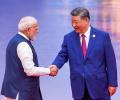
India's dual pursuit of a robust strategic partnership with Washington and a pragmatic, tension-management policy with Beijing represents the essence of modern multi-alignment. By embracing economic pragmatism, learning to compartmentalize political differences, and engaging in continuous dialogue, India can secure its borders, grow its economy, and contribute to a stable, multipolar Asian century, points out Ambassador Rajasekhar.

The United States' historical strategic alignment with Pakistan, dating back to the Cold War, has consistently aimed to create a political and military parity with India, despite India's significantly larger size and resources. This long-standing relationship continues to influence regional dynamics, particularly in West Asia and the Indo-Pacific.

'It was diminishing even before Trump came to power.' 'The US was at the centre of the global economy. That position is going to become less and less important and less central.'

The delegations from the US and Iran head to Islamabad on Friday, carrying a ceasefire that is already fraying, a Strait that is technically open and practically closed, and a negotiating agenda that would challenge even parties actually negotiating in good faith, which these groups are not. Prem Panicker continues his must read blog on the Iran War.

'The next two to three weeks will not be decided in Washington.' 'They will be decided in Tehran, in whatever calculation Iran makes about the costs of continued resistance against the costs of appearing to have yielded.'

The report evaluates the likely military, strategic and international fallout for China under scenarios ranging from a "major war" to a "minor conflict" with Taiwan, Focus Taiwan said.
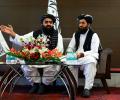
'During the 5-day visit, Amir Khan Muttaqi would have, conceivably, bumped into our powerful security agencies one way or another and some interaction would have ensued, which, in turn, can lead to future dealings.' 'Indeed, this will be the one crucial template of the Indo-Afghan relationship that Pakistan will be monitoring closely,' points Ambassador M K Bhadrakumar.

An influential US lawmaker claims his visit to India helped catalyze "early signals" that New Delhi may reduce its imports of Russian oil, a step he described as "meaningful" in weakening Moscow's ability to fund its war in Ukraine.
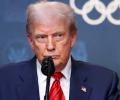
US President Donald Trump reiterated his claim that he "settled" the conflict between India and Pakistan, suggesting it averted a potential nuclear war. He also claimed that several planes were shot down during the conflict.
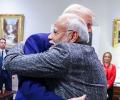
One must wonder whether Mr Modi's efforts to wine and dine the Big Two of today's world were seen as a sign of weakness rather than a proffered arm of friendship, points out R Jagannathan.

Shigeru Ishiba is expected to prioritise strengthening Japan's military capabilities and fostering deeper international partnerships, particularly with India, with whom Japan shares significant strategic interests, explains Dr Rajaram Panda.
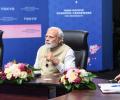
As US President Joe Biden launched a new trade deal with 12 Indo-Pacific nations, including India, to enhance trade, economic and investment opportunities, China, which sees the pact as a threat to its dominance in the region, went on the offensive against it, promising more opening up, while the official media here termed it as "economic Nato".
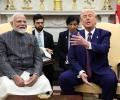
'Trump's aggressive stance towards China and preference for military posturing could shift the Quad's balance towards overt militarisation.'
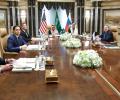
The US move to align with Russia is prompted by fear of a Sino-Russian joint threat. Russia, fully aware of its military vulnerability vis a vis China may cautiously welcome the American move, assesses Colonel Anil A Athale (retd).
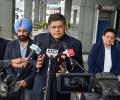
'It is high time that the 'war on terror' is removed from our diplomatic toolbox.' 'Certainly, our parliamentarians have no role in it,' asserts Ambassador M K Bhadrakumar.
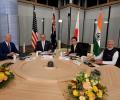
Saturday's Quad meeting in Delaware is taking place against the backdrop of China's assertive behaviour in the South China Sea, its sabre-rattling in the Taiwan Strait and increasing footprints in the Pacific and Indian Ocean, asserts Rup Narayan Das.

'Countries around the world are like passengers aboard the same ship. For the ship to navigate the storm and sail toward a bright future, all passengers must pull together'

New Delhi has reached out to Moscow while waiting for a new president in Washington. New Delhi knows well that in international relations, there are no permanent friends or foes, only permanent national interests, points out Dr Rup Narayan Das.
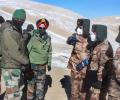
"China creeps towards hegemony in Asia, threatens India's borders, and treats other countries as junior partners, Indian-American Congressman Ro Khanna said.

'Now it's for India to also make certain decisions. The sky's the limit. You've got to be strategic.'

Now, as before, India's vote at the UN was dictated by paramount national interests. Though the Indian vote was 'neutral', its explanation was explicit in its criticism of the Russian actions. India took back with the left hand what it had given with the right, explains Ambassador T P Sreenivasan.

There is nothing to be worried about as bilateral ties are robust with solid foundations. Both are on the same page on the economic and defence/security ties bilaterally and globally and that shall continue irrespective of change in political dispensation in either country, points out Dr Rajaram Panda.

The scaling up of the India-US strategic partnership to the level of non-NATO ally with defence deals, sharing and transfer of defence technology, interoperability, joint collaboration and joint production of defence equipment has exacerbated Moscow's anxiety, notes Rup Narayan Das.

The US "Indo-Pacific Strategy" is bound to be a failed strategy, Wang said in the comments posted by the Chinese foreign ministry on its website.

'Putin has set aside all the rules and now he is deciding the rules.'

China, the Ukraine crisis and Quad will dominate the discussions, observes Dr Rajaram Panda.
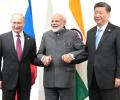
Asserting that both Prime Minister Narendra Modi and Chinese President Xi Jinping are 'responsible' leaders, Russian President Vladimir Putin on Saturday said they both are capable of solving issues between the two countries, and that it was important that no 'extra-regional power' should interfere in the process.

Notwithstanding how the current impasse is solved, at some point in the future, Russia will realise that just as centuries ago it developed the paradigm of securing its heartland's safety through annexing vast buffer zones between itself and the enemy, a more modern security is possible only through friendly relations and sustainable peace, observes Shyam G Menon.

'Putin is in danger of losing face in his Ukrainian adventure. His bluster is a response to this.'

'India enjoys the maneuverability of a coming big power.' 'It is this possibility that has persuaded Moscow to humour India and stayed Washington from getting punitive about India's neutrality on the Ukraine issue.'

Denmark is opposed to Russian athletes participating in the Paris Olympics next year even under a neutral flag

More than India's alignment with the Quad, India's defence cooperation and partnership with the USA is of critical importance, notes Rup Narayan Das.

The designation means that Pakistan will join an exclusive club of nations that are given preferential treatment by the US in areas of foreign aid and defence cooperation.

Australia are still planning to host Afghanistan in the countries' first ever Test, Cricket Australia (CA) said, despite uncertainty raised after the Taliban seized power in the South Asian country.
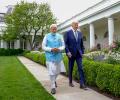
'India will want a lot of help from the US, but it's not going to want US troops.'
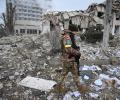
Reconstruction efforts after the Russia-Ukraine war will be dominated by the heft of the membership of major nations across international organisations. India is hamstrung because it does not play host to any major global institution nor does it hold positions of significant influence in the ones in which it has membership. As a result, the world's sixth largest economy is obliged to follow the rules set by most of them.
